Posts by: Matin Durrani
Your guide to the nanotech world
By Matin Durrani

If you’re too busy to keep up to date with all the latest research findings in the ever-growing field of nanotechnology, then the latest Physics World focus issue is the place to get up to speed.
The focus issue, which can be read here, has been produced in association with our sister publication nanotechweb.org and examines some of the latest advances and applications in nanotechnology.
Published in addition to our monthly magazine, the focus issue includes our pick of the top 20 applications of graphene – the amazing carbon nanomaterial that led to the 2011 Nobel Prize for Physics.
There is advice for anyone thinking of founding a nanotech start-up, a look at the potential of using nanotubes to generate “thermopower waves” and a report on sculpting materials at the nanoscale.
It also includes a video filmed at the Manchester University lab of Andre Geim, where the Nobel-prize-winning graphene work was carried out, showing how this ultrathin 2D carbon material is made.
The message of the issue is clear: nanotechnology is swiftly moving beyond pure research and scientists are finally reaping the benefits of new nanomaterials.
As always, let me know your comments on any of the topics covered by e-mailing me at pwld@iop.org.
The June 2012 issue of Physics World is out now
By Matin Durrani

For any publication, it is never wise to spend too much time talking about itself. In the case of Physics World, our main aim is to reflect and report on the breakthroughs, events, personalities and issues in the global physics community – and to do so in a timely, accessible, accurate and entertaining way. Still, it seems churlish for me not to highlight the fact that Physics World has been named “best magazine” in the “professional association or royal college” category by MemCom – a UK-based organization that supports membership societies, charities and not-for-profit bodies.
As for the new issue, which is just out, my pick this month is the wonderfully written feature by Pablo Arrighi and Jonathan Grattage on the idea that our universe can be modelled as a giant computer. Their article is mind-boggling and certainly raises as many questions as it answers. You can read the article here but to enjoy the article and images in all their glory, remember that members of the Institute of Physics (IOP) can access the entire new issue online free of charge through the digital version of the magazine by following this link or by downloading the Physics World app onto your iPhone or iPad or Android device, available from the App Store and Google Play, respectively.
Here’s a rundown of other highlights of the issue.
• India sticks to the thorium trail – A three-stage plan that will see India generate nuclear power from its vast reserves of thorium is gaining ground, but huge challenges remain ahead, as Matthew Chalmers reports.
• The only woman in town – As the only female physics faculty member based at the University of Tokyo, Mio Murao talks to Michael Banks about the challenges Japan faces in getting more women into the subject.
• Quantum guidebooks – Fresh from his appearance in the latest Physics World podcast, which examined the enduring popularity of books about quantum mechanics, Robert P Crease surveys the many tour guides to the quantum world.
• Fixing the climate – While nations attempt to limit global warming by reducing carbon emissions, Colin Baglin argues that such actions will fail to solve the problem if geoengineering is not used in the short term.
• Bringing down the trash – The density of junk orbiting the Earth is at or near a critical value beyond which this man-made debris will self-perpetuate, forming many smaller pieces that are even more of a problem. Stephen Ornes reports on the latest ideas about how to bring down the trash.
• Now we’re cooking – From the very first oven to the foamed foods of modernist cuisine, physics has played a dominant role in food throughout history. But now the subject has the potential to solve a major global cooking issue, says Sidney Perkowitz.
• Changing the Hamiltonian – Trained to understand particles rather than people, physicists who become managers often struggle with human-resources challenges such as motivating and developing employees. Properly applied, however, a knowledge of physics can be a management boon, not a burden, as Graham Boyd demonstrates.
• Twin-tub theory – Kevin McGuigan recalls his near-horror with his mam’s washing machine.
If you’re not yet a member, you can join the IOP as an IOPimember for just £15, €20 or $25 a year via this link. Being an IOPimember gives you a full year’s access to Physics World both online and through the apps.
Higgs spotted in Bristol

(Courtesy: Dirk Dahmer)
By Matin Durrani
It’s been a hectic few days for 82-year-old Peter Higgs.
The retired Edinburgh University particle theorist, after whom the famous boson is named, has been in Bristol for the last two days undertaking a series of public engagements.
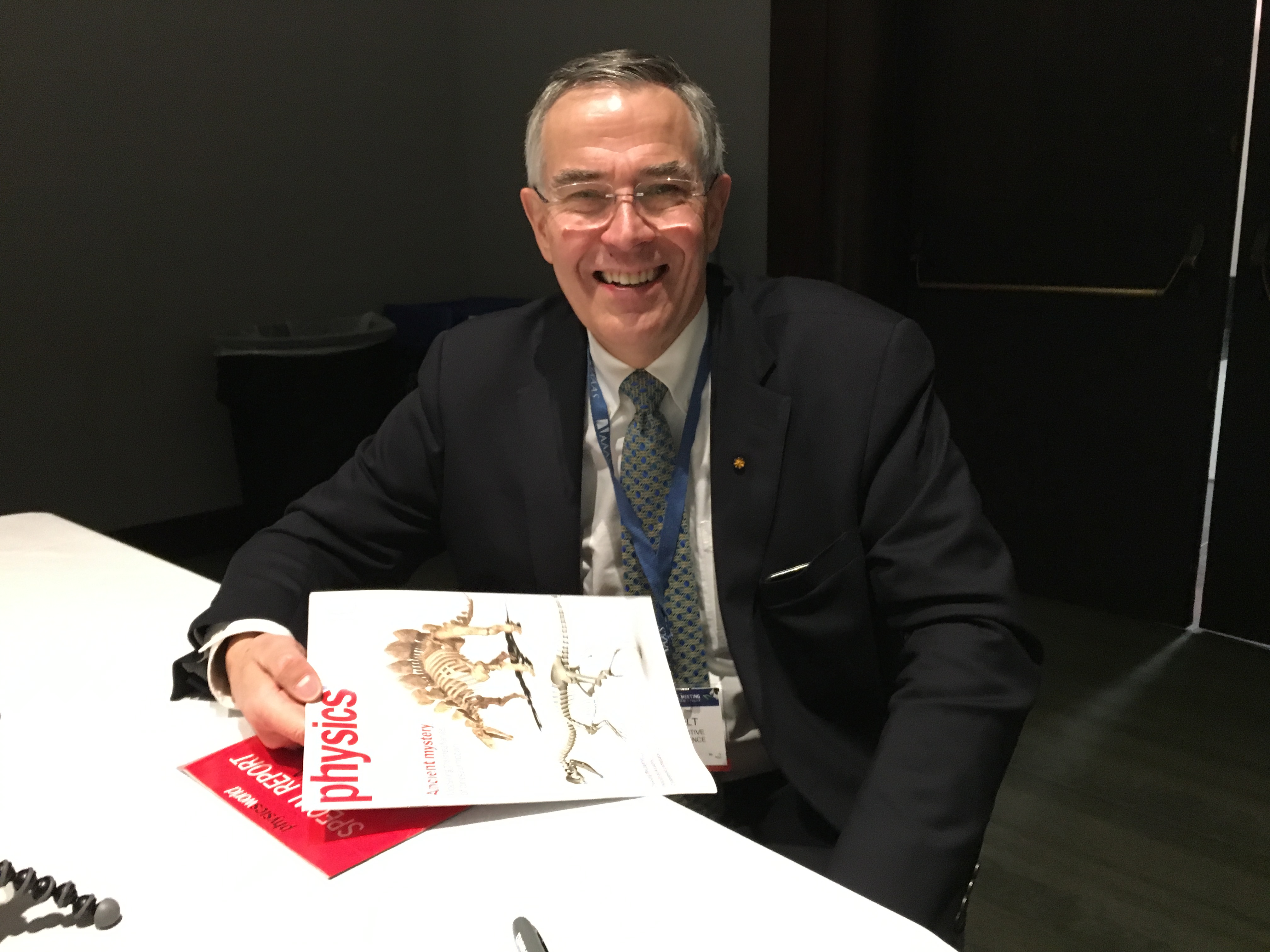
First up was a visit yesterday to Cotham School, where Higgs was a pupil for five years during the Second World War when his father – a BBC engineer – was posted to the city. Higgs is in fact not the only great physicist the school has produced – the other stellar pupil was Paul Dirac, whose name the young Higgs used to see displayed prominently on the school’s honours boards. Higgs, who was back at the school for the first time since the war, signed autographs as he opened a new science block, appropriately named The Dirac–Higgs Science Centre, accompanied by the media.
In the evening, the self-effacing Higgs then took part in an event at St George’s Bristol that was part of the city’s Festival of Ideas. In front of an audience of several hundred people, he was joined on stage by Graham Farmelo, author of the award-winning Dirac biography The Strangest Man, who outlined Dirac’s achievements and his links with Bristol. Higgs then took part in a conversation with Observer science editor Robin McKie, who asked him, among other things, how he would celebrate if the Higgs boson is found. To much amusement, Higgs replied that he had “a leftover bottle of champagne from Christmas” but that he hadn’t yet “put it in the fridge”.
Today, Higgs paid a visit to IOP Publishing, where I interviewed him for Physics World. Inspired by questions posted by readers on our Facebook page and sent to us via Twitter, I quizzed Higgs about his early work on symmetry breaking, his thoughts about the search for the Higgs at CERN and his wider views on physics. We’ll be posting the interview online in the next month or two, so stay tuned for that.
Higgs still remains embarrassed at having a particle named after him, feeling that it places too much of the credit on him at the expense of other theorists. But during our interview, even he on occasion dropped the “so-called” from the “so-called Higgs boson”, the “so-called Higgs field” and the “so-called Higgs mechanism”. It just gets tiring after a while, I suppose.
As I write, the indefatigable Higgs is off to give a colloquium in the main lecture theatre at the physics department at the University of Bristol, entitled “My life as a boson”. Over lunch I asked Higgs if that wouldn’t be the perfect title for his autobiography. Self-effacing as ever, Higgs replied that, when it came to writing books, he was simply “too lazy”. So if you want to hear more about his life, you’ll have to wait for the Physics World interview.
The May 2012 issue of Physics World is out now
By Matin Durrani

When it comes to scientific events that can get the whole world thrilled – researchers and non-scientists alike – astronomy wins hands down. Eclipses, comets or meteor showers, for example, are rare enough to get anyone with even a passing interest in science excited. But for true once-in-a-lifetime astronomical events, nothing can beat next month’s transit of Venus, in which our sister planet passes across the face of the Sun as viewed from Earth.
Transits of Venus occur in pairs eight years apart, with each pair separated by gaps of more than a century. The last transit occurred in 2004, meaning that the upcoming transit on 5–6 June will almost certainly be your only chance to see this rare astronomical alignment, as it will not occur again until 2117. For more on the science and history of this astronomical spectacular, don’t miss the fantastic feature “Venus: it’s now or never” by one of the world’s leading transit experts, Jay Pasachoff.
You can read the article here but to enjoy the article and images in all their glory, check out the May 2012 issue of Physics World. Members of the Institute of Physics (IOP) can read the new issue online for free right now through the digital version of the magazine by following this link or by downloading the Physics World app onto your iPhone or iPad or Android device, both available from the App Store and Google Play, respectively. The digital version lets you read, share, save, archive and print articles – either fully laid out or in plain-text view – and even have them translated or read out to you.
If you’re not yet a member, you can join the IOP as an imember for just £15, €20 or $25 a year via this link Being an imember gives you a full year’s access to Physics World both online and through the apps. To whet your appetite still further, here’s a quick summary of what else is in the new issue. And remember, let me know what you think of any of the topics by e-mailing me at pwld@iop.org.
• Atmospheric tales – Robert P Crease reveals why the discovery of Venus’s atmosphere is still so controversial.
• Quantum technologies: an old new story – Technologies based on the
properties of quantum mechanics have been around for many years, but Iulia Georgescu
and Franco Nori argue that we need a new definition for “quantum technologies”.
• Japan’s X-ray vision for the future – With the world’s first “compact” X-ray free-electron laser having opened its doors to users in March, Michael Banks travels to the remote SACLA facility in the mountains of western Japan to find out more about this ambitious new project.
• Fukushima fallout – Steven Judge and Hiroyuki Kuwahara report on efforts to monitor radioactive contamination in areas near the stricken Fukushima Daiichi reactor.
• Defeating diffraction – Once thought to offer imaging at unlimited resolution beyond that permitted by diffraction, superlenses never quite worked in practice. Now, physicists have a host of other ideas to make perfect images, but can these concepts succeed where superlenses failed? Jon Cartwright reports.
• Playing the game – Catherine Goode describes how a degree in physics and a childhood passion for computer and video games led her to a career in game design.
• Towards a Standard Model of finance – Andrew Aus looks at links between physics and finance in this month’s Lateral Thoughts column.
The April 2012 issue of Physics World is out now
By Matin Durrani

Alien plants, coffee stains and the sinking of the Titanic are three topics you probably wouldn’t expect to see back-to-back in any publication, let alone the April issue of Physics World. Strange as it may seem, however, there is a physics theme to them all. So for your delight, here’s a quick summary of what’s in the new issue – and there are details at the end of this blog about how to access the entire content of the magazine via our digital issue and apps. And remember, let me know what you think of any of the topics by e-mailing me at pwld@iop.org.
• Taking on the climate – James Dacey interviews the US cosmologist Richard Muller, who has started two separate projects that both led to Nobel prizes and who is now tackling the nature and extent of global warming.
• Putting Goonhilly back on the map – Michael Banks reveals how a derelict communications facility in Cornwall, UK, is being refashioned into a state-of-the-art astronomy facility that could one day join the UK’s leading array of radiotelescopes
• Mending the broken pipe – Lesley Cohen from Imperial College London examines what can be done to encourage more women into physics.
• The cat that never dies – Physics World columnist Robert P Crease wonders why the idea of Schrödinger’s cat is still so alive today, some 75 years after its birth.
• The perfect storm – a century on from the Titanic tragedy, Richard Corfield says that the cascade of fateful events that led to her demise was partly caused by the science of the ship’s construction.
• Life under alien skies – Lewis Dartnell from University College London describes some preliminary, but increasingly well founded, efforts to predict what alien plants and animals might look like.
• Say goodbye to coffee stains – H Burak Eral, Dirk van den Ende and Frieder Mugele from the University of Twente explain how the stains that liquids leave behind, which can be a major annoyance in some biology techniques, can be altered for the better using a technique called electrowetting.
• We are cosmic nomads – in this month’s Lateral Thoughts, Pangratios Papacosta from Columbia College in Chicago muses on our home in the universe.
Members of the Institute of Physics (IOP) can read the new issue online free right now through the digital version of the magazine by following this link or by downloading the Physics World app onto your iPhone or iPad or Android device, available from the App Store and Google Play, respectively. The digital version lets you read, share, save, archive and print articles – either fully laid out or in plain text view – and even have them translated or read out to you.
If you’re not yet a member, you can join the IOP as an imember for just £15, €20 or $25 a year via this link. Being an imember gives you a full year’s access to Physics World both online and through the apps.
Multiverses in the movies
By Matin Durrani
Far from being an arcane concept in theoretical physics, the idea of “parallel worlds” and “parallel universes” has for many years served as a source of inspiration for numerous artists, movie-makers and writers, as the Stony Brook University philosopher and historian Robert P Crease discussed in his column for Physics World last December.
The latest – and probably not the last – example of multiple universes in popular culture comes with a new German film released earlier this month entitled Schilf, which means “Reeds” in English.
The film’s based on the bestselling book of the same name by German author Juli Zeh, the English translation of which, rather confusingly, was entitled Dark Matter in the UK and In Free Fall in the US.
Reviewing the book for Physics World in 2010, US science writer Jennifer Ouellette called it “a compelling intellectual thriller”, which she commended for its “meticulous plotting…and lyrical turns of phrase”. You can read her review here.
Anyway, the film version, like the book, features – unusually in the movie world – not one, but two bona fide physicists, in the form of a professor at the University of Jena called Sebastian Wittich (played by Mark Waschke) and an old pal from his student days called Oskar Hoyer (Stipe Erceg), who’s now based at CERN.
According to Ouellette’s review of the book, Sebastian and Oskar are passionate rivals when it comes to physics, and the story begins with the pair discussing the philosophical implications of the possibility of parallel worlds, before quickly veering off to include a kidnapping, a ransom, a grisly death and the unravelling of Sebastian’s life.
“Eventually, an unorthodox detective with a love of physics and an inoperable brain tumour steps in to solve his final case by connecting these seemingly random events,” Ouellette writes.
I’ve only watched the trailer for the film – directed by Claudia Lehmann – so I can’t comment on how closely it follows the novel or if the movie is worth watching.
But the trailer itself looks okay, with realistic-looking shots of a physics lecture hall and a scene inside Sebastian’s home, where his son starts going on about Schrödinger’s cat. Then the cheery (cheesy?) accordion music turns predictably sinister, various mobile phones go off, assorted trains/cars/bikes come and go, an old, beardy guy with dark glasses and a scarf stumbles into view, before a character, with his back to us, admits “I’ve killed someone – but not in this world.” There’s also a glimpse of a place that might, or might not, be CERN.
By the way, a gripe of mine: why is it that mobile phones in movies never have silly ring tones?
More details of the film can be found at IMDb.com.
Physics and the Earth: all you need to know
By Matin Durrani

If you’re a member of the Institute of Physics (IOP), you’ll have had access for more than a week now – through our apps, in print or online – to the bumper 92-page March issue of Physics World magazine, which features a series of fabulous articles and images on the theme of “Physics and the Earth”.
If you’re not yet a member of the IOP, then to get a taste of what you’re missing out on each month, we’re offering a free PDF download of the March issue via this link.
Here’s a brief outline of what’s in the March issue and I’ve included details at the end of this blog about how to join the IOP so that you can get your hands on Physics World each and every month. Joining is easy and costs just £15, €20 or $25 a year.
• Gianpaolo Bellini and Livia Ludhova describe how geoneutrinos generated through radioactive decay within the Earth are providing a new technique for understanding our planet.
• François Pétrélis, Jean-Pierre Valet and Jean Besse explain why they think that the movement of the Earth’s plates could be linked to the rate of reversal of the Earth’s magnetic field.
• See what progress is being made in understanding the Earth’s core – including the bizarre possibility that it may hide huge crystals of iron some 10 km long.
• Learn more about the controversy over fracking, which involves pumping sand and chemicals into shale deposits to release trapped natural gas.
• Check out our interview with Robert Hazen, the head of the Deep Carbon Observatory, who wants to find out what happens to carbon that gets subducted into the Earth’s core.
• Mike Weightman, chief inspector of nuclear installations and executive head of the Office for Nuclear Regulations in the UK, describes what lessons we can learn from the incident at the Fukushima Daiichi plant one year on.
• Enjoy a series of spectacular images of the Earth from afar, showing the power of Earth observation.
• Find out how the latest advances in earthquake forecasting can give the odds that an earthquake above a certain size will occur within a given area and time.
Download a PDF of the issue now.
Remember, to get Physics World each month, you can join the IOP as an imember for just £15, €20 or $25 a year via this link. Being an imember gives you a full year’s access to Physics World, both online and through the apps.
Members of the IOP can also read the March issue through the digital version of the magazine by following this link or by downloading the Physics World app onto your iPhone or iPad or Android device, available from the App Store and Android Marketplace, respectively. The digital version lets you read, share, save, archive and print articles – either fully laid out or in text view – and even have them translated or read out to you.
To let us know what you think about the March issue, please e-mail us at pwld@iop.org.
Enjoy the issue!
The March 2012 issue of Physics World is out now
By Matin Durrani

The March issue of Physics World magazine is now out, featuring a series of fabulous articles and images on the theme of “Physics and the Earth”. Here’s a brief outline of what we have on offer and there are details at the end of this blog about how to access the entire content of the issue.
• Find out how the latest advances in earthquake forecasting can give the odds that an earthquake above a certain size will occur within a given area and time.
• Gianpaolo Bellini and Livia Ludhova describe how geoneutrinos generated through radioactive decay within the Earth are providing a new technique for understanding our planet.
• François Pétrélis, Jean-Pierre Valet and Jean Besse explain why they think that the movement of the Earth’s plates could be linked to the rate of reversal of the Earth’s magnetic field.
• See what progress is being made in understanding the Earth’s core – including the bizarre possibility that it may hide huge crystals of iron some 10 km long.
• Learn more about the controversy over fracking, which involves pumping sand and chemicals into shale deposits to release trapped natural gas.
• Check out our interview with Robert Hazen, the head of the Deep Carbon Observatory, who wants to find out what happens to carbon that gets subducted into the Earth’s core
• Mike Weightman, chief inspector of nuclear installations and executive head of the Office for Nuclear Regulations in the UK, describes what lessons we can learn from the incident at the Fukushima Daiichi plant one year on.
• Enjoy a series of spectacular images of the Earth from afar, showing the power of Earth observation.
Members of the Institute of Physics (IOP) can read the new issue online for free right now through the digital version of the magazine by following this link or by downloading the Physics World app onto your iPhone or iPad or Android device, available from the App Store and Android Marketplace respectively. The digital version lets you read, share, save, archive and print articles – either fully laid out or in easy-to-read text view – and even have them translated or read out to you.
If you’re not yet a member, you can join the IOP as an imember for just £15, €20 or $25 a year via this link. Being an imember gives you a full year’s access to Physics World both online and through the apps.
A free PDF of the issue will also be available for download from this site from 8 March.
Quantum weirdness

By Matin Durrani
Quantum physics is notoriously counter-intuitive and difficult to grasp, which is perhaps why the subject is often invoked to explain other seemingly counter-intuitive and difficult-to-grasp areas of life.
But that doesn’t mean that wheeling out the subject necessarily makes any sense.
So here’s to the former Bishop of Southwark, Thomas Frederick ‘Tom’ Butler, whose comments on the Thought for the Day slot on BBC Radio 4 this morning (at about 1.47) are a classic of the genre.
The bishop begins, for some reason, by talking about the search for the Higgs boson (or Higgs “bos’un” as he irritatingly puts it) at CERN’s Large Hadron Collider, which, he reveals to the world, “will shortly be reactivated”. (I presume he means restarted after the scheduled winter shut-down as the scientists on the machine have happily been taking data for more than two years now.)
Having brought up the LHC, Butler then jumps suddenly into quantum physics, bemoaning his lack of understanding of the subject. But that’s okay, we’re told, because Niels Bohr once said that “those who aren’t shocked when they first come across quantum theory can’t possibly have understood it”. (Quote a heavyweight from science – that’ll impress the listeners.)
And so to the heart of the matter: fundamental entities can be both particles and waves, which is, er, a bit like religion really. “Paradoxically it [quantum mechanics] has made some of the traditional problems of the nature of God easier to understand,” says the bishop, pointing out, for example, that Jesus is both human and divine.
Butler admits he found it hard, when he was younger, to come to terms with this paradox. “I found this both/and faith world difficult to grasp,” he says. “Surely this paradox couldn’t be right?”
Ah, but all’s well now, thanks to quantum physics. “It tells us the world is paradox. The fundamental nature of existence is both/and.”
But if you have any lingering doubts over the validity of quantum physics, don’t worry. “Hopefully we’ll soon have the Higgs boson to give the theory the stamp of approval.”
You can relive the whole item here – jump to about 1.47 minutes.
Closing the gender gap

By Matin Durrani
My eye was caught this morning by a new report from the Institute of Physics, which publishes physicsworld.com, about the number of physicists at UK universities.
Entitled Academic Physics Staff in UK Higher Education Institutions, you can read the full report here, but what I found particularly interesting were the data on women in physics.
The report reveals that the proportion of staff in UK physics departments who are women has risen steadily from 13% in 2003/04 to 16% in 2009/10. (See figure above: data in it are from the UK’s Higher Education Statistics Agency.)
As one might expect, the biggest rises are at more junior levels, with the proportion of female lecturers going up from 11.3% to 19.8% over that period. Senior-lecturer numbers have increased from 9.0% to 11.2% and although the proportion of female professors has risen form 3.9% to 5.5%, women in these top positions are still very much in the minority.
Given that women make up about 22% of UK physics undergraduates, is it too much to hope that in 15 or 20 years’ time women will also make up a fifth or so of physics professors?
Another intriguing statistic concerns the highly international level of UK physics, particularly among women. According to the report, the proportion of female staff at UK universities who are not from the UK has risen from 46% in 2003/04 to 51% in 2009/10. This is much higher than the fraction of male non-UK nationals at UK universities, which has gone up from 31% to 40% in the same period.
Overall, across both men and women, the biggest proportion of non-UK staff working in UK physics departments come from Germany, followed by Italy, the US, China, Russia, France, India, Greece and the Netherlands. Make of that what you will.
You can read the full report here.