
![[IOP]](http://images.iop.org/cws/icons/themes/phw/colophon-small.png)


Posts by: Hamish Johnston
Meteoroid seen from space, Nobel laureates speak their minds on group awards and keeping up with technology
By Hamish Johnston
Fix your eyes on the upper-right portion of the above video and pay particular attention about seven seconds into the footage. You will see a fireball falling through Earth’s atmosphere. The video was taken from the International Space Station by the Italian astronaut and prolific photographer Paolo Nespoli.
Was the fireball a piece of space junk, or perhaps a tiny piece of asteroid? And how fast was it moving? For an analysis of what Nespoli may have seen, go to: “The backstory: Paolo spots a meteoroid from the ISS”. There you will also find a fantastic gallery of photographs taken by Nespoli.
View all posts by this author | View this author's profile
LIGO bags another black-hole merger
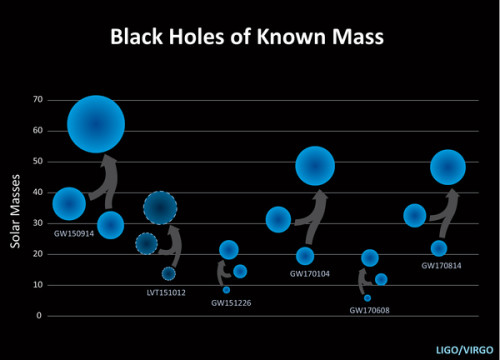
The other ones: five observed black-hole mergers, plus a possible merger shown with dashed outlines (Courtesy: LIGO)
By Hamish Johnston
They have done it again. Physicists working on the LIGO gravitational-wave detectors in the US have announced the observation of another black-hole merger.
This event was spotted on 8 June 2017 and involved two black holes combining to form a black hole 18 times more massive than the Sun. The Virgo detector in Italy did not see the event because it was not switched on. This is the fifth observation of gravitational waves from merging black holes seen by LIGO, which along with Virgo also detected a signal in August from the merger of two neutron stars. Unlike the neutron-star event, no electromagnetic radiation was seen from the merger.
View all posts by this author | View this author's profile
Name a distant world, fireworks through a diffraction grating, radio telescope helps Puerto Rican relief
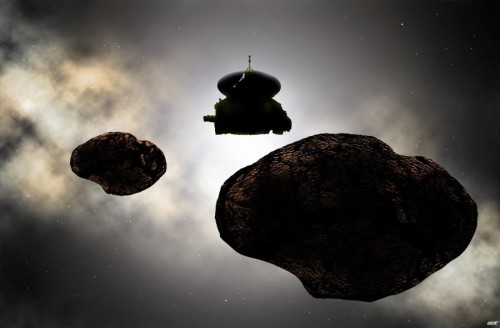
Double act: artist’s impression of the (486958) 2014 MU69 flyby. (Courtesy: NASA/Johns Hopkins University Applied Physics Laboratory/Southwest Research Institute/Carlos Hernandez)
By Hamish Johnston
Here is an opportunity to put your mark on the solar system. NASA and the team behind the New Horizons spacecraft are asking the public to nickname the mission’s next flyby target. Located in the Kuiper belt and called “(486958) 2014 MU69”, the target is likely to be two objects – each about 20 km across – in a very close orbit. So, a name like “Cheech and Chong” could be a winner. To enter, go to “Help us nickname a distant world”.
View all posts by this author | View this author's profile
Putting a stamp on gravitational waves, LEGO’s Women of Nasa, physicist competes in bake-off
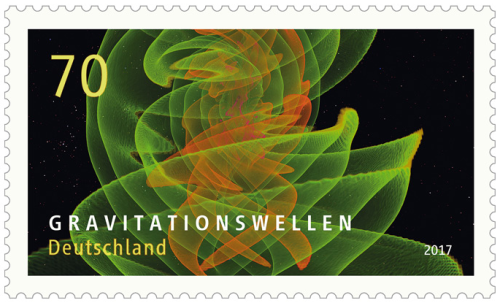
Cosmic delivery: German stamp commemorates gravitational waves. (Courtesy: German Federal Ministry of Finance)
By Michael Banks and Hamish Johnston
For those wanting to add a physics twist to your season’s greetings, you now can thanks to Germany’s Federal Ministry of Finance. It has announced two new stamps that will go on sale in the country on 7 December. A €0.40 stamp will feature the European Space Agency’s Gaia satellite and will be the first German stamp to include a metallic coating. Gaia was launched in 2013 to measure the positions and distances of astronomical objects, including stars, planets as well as comets. The ministry also announced a €0.70 stamp that depicts the gravitational waves that emerge from the collision of two black holes. The simulation was made by researchers at the Albert Einstein Institute (AEI) in Potsdam, Germany. “The ministry did not announce whether letters equipped with the new gravitational-wave stamp will be transported at the speed of light,” states an AEI press release.
View all posts by this author | View this author's profile
Happy Dark Matter Day
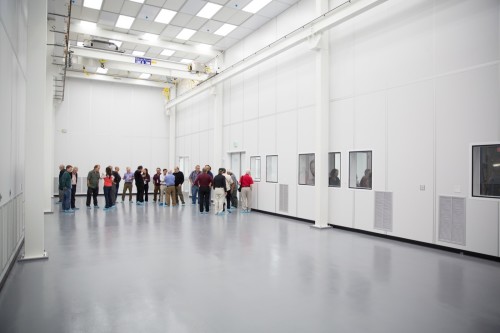
Darkness to light: the LSST clean room (Courtesy: LSST)
By Hamish Johnston
“On and around October 31, 2017, the world will celebrate the hunt for the unseen…” is the message on the Dark Matter Day website, which has been put together by physicists at universities and research labs across the globe. The site has links to more than 100 online and real-life events taking place in October and November of this year in more than 20 countries worldwide.
Why celebrate dark matter? Why not? After all, the elusive dark stuff appears to account for about 85% of the matter in the universe and its gravitational pull defines the fabric of the cosmos at galactic and greater distance scales. Furthermore, working out exactly what dark matter is could provide valuable information about physics beyond the Standard Model.
View all posts by this author | View this author's profile
Dialogues on physics, great women who changed science, a virtual reality journey to six exoplanets
By Hamish Johnston
I spend an hour or so every day looking at physics-related websites including several dozen blogs by professional physicists. One of my favourites is Asymptotia by Clifford Johnson, a theoretical physicist at the University of Southern California. Johnson is a talented visual artist and next month he has a new graphic book out called The Dialogues. The above video gives you a taste of what to expect. (more…)
View all posts by this author | View this author's profile
What gravitational waves did (and didn’t) tell us about GW17081
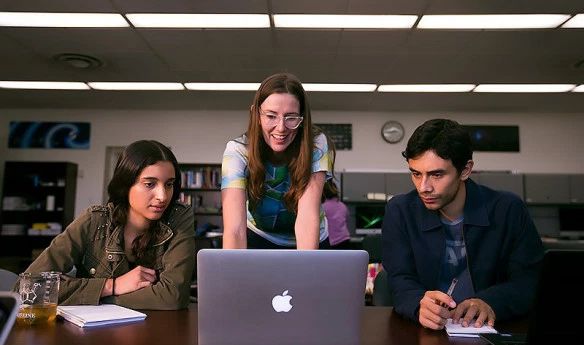
Rotating into view: Jocelyn Read (centre) and undergraduate students Isabella Molina (left) and Erick Leon. (Courtesy: CQG+)
By Hamish Johnston
The GW170817 neutron-star merger was by no means an instantaneous event. Physicists working on the LIGO-Virgo gravitational-wave detectors were able to watch the two stars spiral towards each other for about 100 s before they merged. Valuable information about the neutron stars has been gleaned from the observation, but the detectors were unable to see the merger itself and its aftermath.
In “The gravitational-wave story of a neutron-star merger”, Jocelyn Read of California State University Fullerton takes up the story at 17 min before the merger. Then, the neutron stars would have been be separated by about 700 km and have an orbital frequency of about 10 Hz.
View all posts by this author | View this author's profile
Neutron star merger as it happened
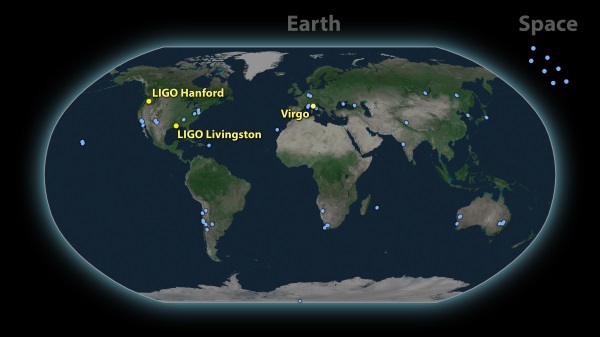
All around the world: observatories that saw GW170817 (Courtesy: LIGO-Virgo)
By Hamish Johnston
At 12:41:20 UTC on 17 August, the Fermi Gamma-ray Space Telescope sent a notice to the astronomy community saying that it had detected a gamma-ray burst. Normally such an event wouldn’t raise much fuss – but this time things would be very different.
Back on Earth, scientists working on the LIGO-Virgo gravitational wave detectors were busy analysing a signal that had arrived about 2 s before the gamma-ray burst and looked very much like the merger of two neutron stars. Such a cataclysmic event is expected to give off copious amounts of electromagnetic radiation including an initial burst of gamma rays.
View all posts by this author | View this author's profile
How does LIGO detect gravitational waves?
By Hamish Johnston
This year’s physics Nobel prize has gone to three physicists who pioneered the LIGO observatory, which in 2015 made the first-ever detection of gravitational waves.
The LIGO detectors are famously capable of detecting changes in length smaller than one thousandth the diameter of a proton.
So how is this done?
View all posts by this author | View this author's profile
Nobel prize heralds new era of multimessenger astronomy
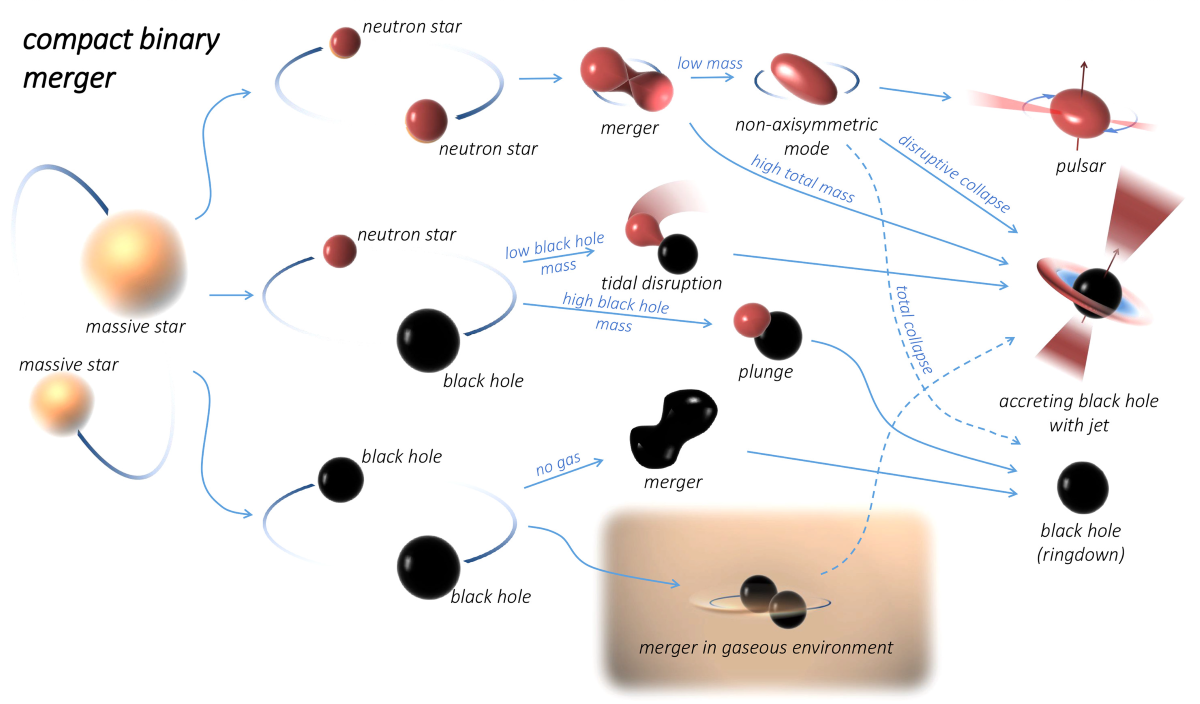
Brave new worlds: what LIGO–Virgo could see. Click on image to expand. (Courtesy: I Bartos and M Kowalski)
By Hamish Johnston
I think it’s safe to say that most Nobel-watchers were predicting a LIGO-related physics prize this year, and for very good reasons.
View all posts by this author | View this author's profile

