
![[IOP]](http://images.iop.org/cws/icons/themes/phw/colophon-small.png)


Posts by: Hamish Johnston
Physics of ski jackets, the eerie sound of thin ice, how figure skaters linger in mid-air
By Michael Banks and Hamish Johnston
Probably with an eye on the Winter Olympics, which starts today, two firms have just released new ranges of high-tech ski jackets. The Swiss technology business Osmotex and the Swiss Federal Laboratories for Materials Science and Technology premiered their new ski jacket at the sport and sportwear international (ISPO) trade fair in Munich. It contains an “electro-osmotic” membrane called HYDRO_BOT in the fabric so that when membrane is switched on with a conventional battery it speeds up the transfer of salt ions across the membrane, taking them away from your sweaty skin. The creators claim it can pump out 10 litres of liquid per square metre per hour. For more details, see the video above.
View all posts by this author | View this author's profile
Happy Hedgehog Day, play like Einstein, Hawking could be in court over NHS
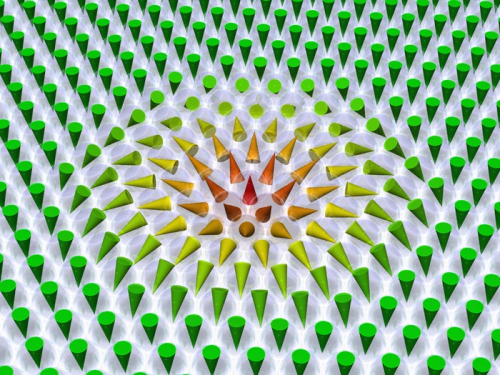
Magnetic hedgehog: illustration of a skyrmion (Courtesy: Wiesendanger Group, University of Hamburg)
By Michael Banks and Hamish Johnston
Today, people are celebrating Hedgehog Day – possibly as an alternative to Groundhog Day, which is a tradition in North America. There is a nice connection between the spiny critters and physics because diagrams illustrating magnetic quasiparticles called skyrmions are sometimes referred to as hedgehogs. This is because the magnetization associated with a skyrmion can resemble the spines of the hedgehog. The above image is from a news story about skyrmion research done by Kirsten von Bergmann, André Kubetzka and Roland Wiesendanger at the University of Hamburg.
View all posts by this author | View this author's profile
Watch the super blue blood moon eclipse live
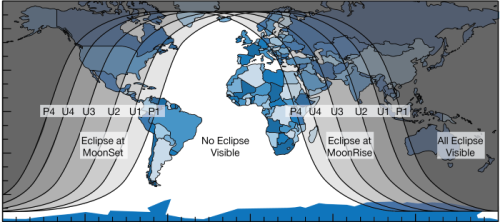
Eclipse watching: where the blood moon will be visible (Courtesy: NASA)
By Hamish Johnston
Tomorrow, people around much of the world should be able to see a lunar triple-whammy. There are two full moons this month, which is a relatively rare occurrence called a blue moon. The Moon is also near its closest approach to Earth, which means that it will loom large in the sky as a super moon.
View all posts by this author | View this author's profile
Physicists bag Australian and Senior Australian of the Year, Doomsday Clock ticks closer to midnight
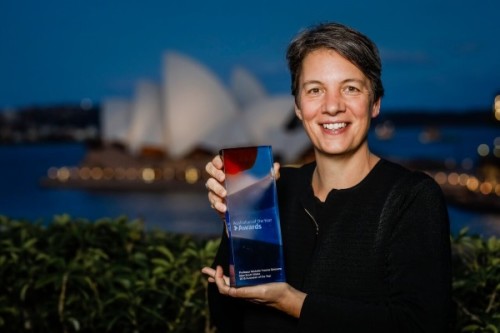
Award winning: Australian of the Year Michelle Simmons (Courtesy: UNSW)
By Hamish Johnston
Today is Australia Day, when the prestigious Australian of the Year award is conferred. This year’s winner is the quantum physicist Michelle Simmons of the University of New South Wales who famously built a transistor from just one atom and also created what could be the world’s thinnest wire. Also honoured today is biophysicist Graham Farquhar of the Australian National University. He is Senior Australian of the Year for 2018 and an expert in photosynthesis. It looks like this will be a bonzer year for physics in Oz.
View all posts by this author | View this author's profile
Lucky physicists, runways renamed as magnetic poles shift, what happened to the Zuma spacecraft?
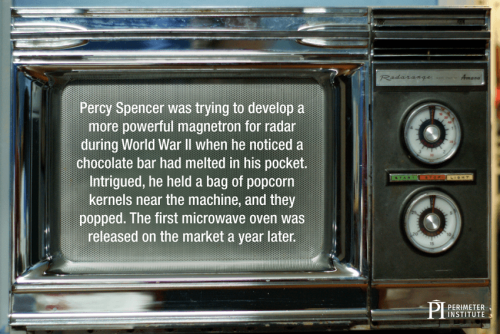
Lucky ping: the invention of the microwave oven. (Courtesy: Perimeter Institute)
By Hamish Johnston
“In the fields of observation, fortune favours the prepared mind,” is a quote attributed to Louis Pasteur and it encapsulates the role of luck in scientific investigation. The Perimeter Institute for Theoretical Physics in Canada has put together a list of eight scientific breakthroughs that benefited from a little luck. Examples include Ernest Rutherford and colleagues measuring alpha-particle backscattering when they were really interested in how the particles travelled through the target – which resulted in the discovery of the atomic nucleus. But my favourite is how the microwave oven was invented, as described above.
View all posts by this author | View this author's profile
US candidates on science policy, your satellite idea could bag a share in £50,000

No denying: Democratic Party candidate Elizabeth Moro. (Courtesy: Elizabeth Moro)
By Hamish Johnston
The Science Debate organization sent out questions about science policy to candidates in the 2018 US elections and the answers are in (at least some of them). Prospective US representatives, senators and state governors were queried on 10 topics ranging from climate change to the importance of science to American prosperity.
James Henry, a Democratic Party candidate in Florida, pointed out: “If you look at your monthly credit card statement and remember the kinds of products and services you spent your money on recently, many of the items purchased probably did not even exist 10 or 20 years ago.” This, he added, is why “It is critical that the government encourage a proactive approach to technology”.
View all posts by this author | View this author's profile
World’s smallest Christmas card and a fusion Christmas number one
By Hamish Johnston
We are winding down for Christmas here at Physics World and taking a well-deserved break before we launch into 2018.
Over the next week or so, stay tuned for festive content including a comic caption competition on Christmas Day that is inspired by this year’s Nobel prize.
View all posts by this author | View this author's profile
New constellations, happy birthday Kristian Birkeland, ‘There once was a chemist from Bath…’
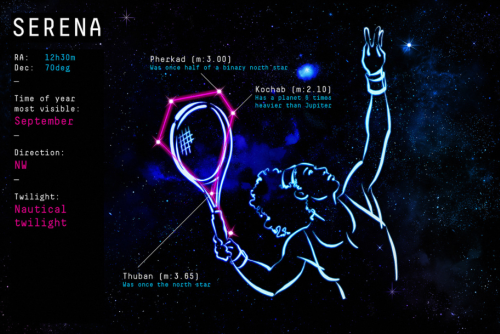
Reach for the stars: constellation Serena (Courtesy: University of Birmingham)
By Hamish Johnston
Astronomers at the University of Birmingham have dreamt-up a set of modern constellations in a bid to inspire young people to take an interest in the cosmos. The constellations are related to eight admirable people including J K Rowling, Usain Bolt, Malala Yousafzai, David Attenborough, Mo Farah and Michael Bond. But my favourite is the tennis racquet shaped constellation Serena, named after Serena Williams.
View all posts by this author | View this author's profile
Star Wars fact or fiction, Wikipedia editor in space, stellarator tour
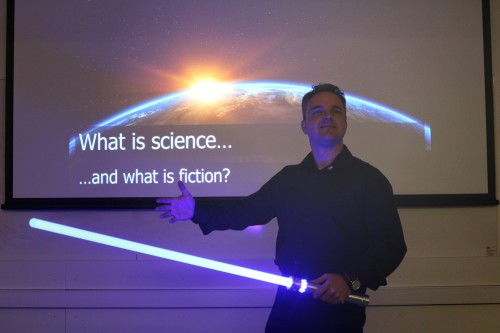
Fact and fiction: Carsten Welsch. (Courtesy: Cockcroft Institute)
By Hamish Johnston
What is it about Star Wars that captivates the imaginations of physicists? Earlier this week Carsten Welsch, who is head of physics at the University of Liverpool and head of communication for the nearby Cockcroft Institute, gave a presentation called “Physics of Star Wars” to an audience of hundreds of secondary school children, undergraduate and PhD students and university staff.
View all posts by this author | View this author's profile
CMS publishes 700 papers, extreme data centres, flat-Earth space programme launches tomorrow
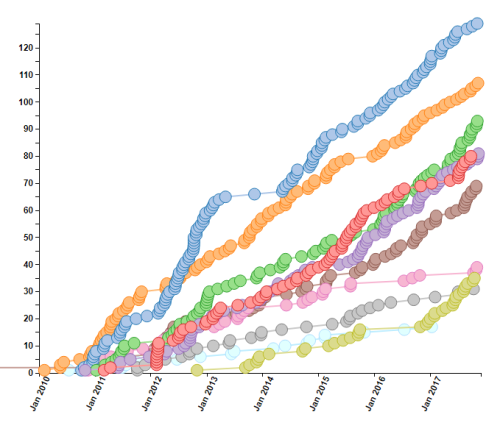
Big data: analysis of CMS papers. See Rao’s article for an interactive version (Courtesy: Achintya Rao/CMS)
By Hamish Johnston
CERN’s CMS collaboration has passed a milestone of sorts at the end of October – it published its 700th research paper. And physicists working on the giant detector on the Large Hadron Collider haven’t stopped there as the tally is now 712 and rising.
CERN’s Achintya Rao has delved into the CMS archives and has chosen his top seven papers. These include the first-ever paper about the detector, which was published in 2008 and, embarrassingly, gets the weight of the detector wrong. Rao has also put together an interactive infographic that looks at 680 papers that analyse data collected by CMS.
View all posts by this author | View this author's profile

