
![[IOP]](http://images.iop.org/cws/icons/themes/phw/colophon-small.png)


Tag archives: Physics World magazine
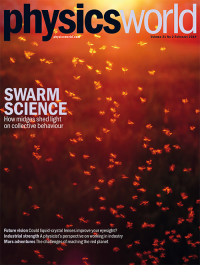
The February 2018 issue of Physics World magazine is now out
 By Matin Durrani
You’ll be delighted to know that the February 2018 issue of Physics World is now out in print and digital format.
In our cover feature this month, science writer Jennifer Ouellette discovers how tiny midges can shed light on collective behaviour in physics. You can also discover from Helen Gleeson how physicists are seeking to create liquid-crystal contact lenses – and learn from Stephen Ornes more about the technological challenges of going to Mars.
Don’t miss either our interview with the physicist who heads Japan’s leading funding agency and find out from astrophysicist Elizabeth Tasker about her experiences as an overseas scientist in the country.
And our veteran North America correspondent Peter Gwynne assesses the impact that Donald Trump has had on US science, one year into his presidency.
Remember that if you’re a member of the Institute of Physics, you can read the whole of Physics World magazine every month via our digital apps for iOS, Android and Web browsers.
Let us know what you think about the issue on Twitter, Facebook or by e-mailing us at pwld@iop.org
View all posts by this author | View this author's profile
See in the new year with the January 2018 issue of Physics World
By Matin Durrani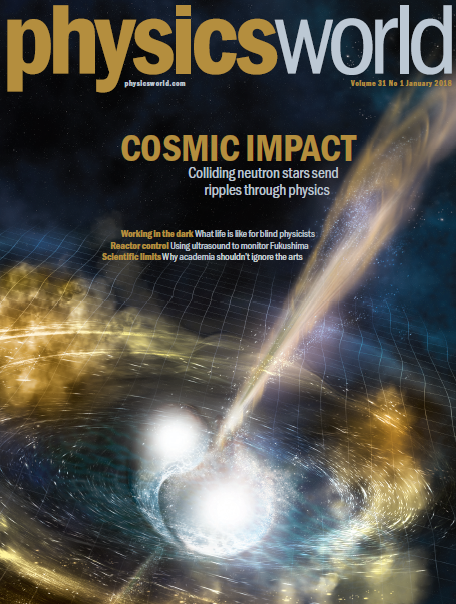
Happy new year and welcome back to Physics World after our winter break. Why not get 2018 off to a great start with the January 2018 issue of Physics World, which is now out in print and digital format.
In our fantastic cover feature this month, Imre Bartos from Columbia University in New York examines the massive impact on physics that last year’s spectacular observation of colliding neutron stars will have.
Elsewhere, Bruce Drinkwater from the University of Bristol explains how he is using ultrasonics to monitor the damaged Fukushima nuclear-power plant in Japan, while science writer Jon Cartwright looks at how technology can help blind physicists.
Don’t miss either our interview with Fermilab boss Nigel Lockyer and do check out our tips for how to brush up your CV if you’re chasing a job in industry.
View all posts by this author | View this author's profile
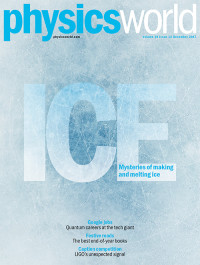
It’s a cracker – the December 2017 issue of Physics World is now out
 By Matin Durrani
The December 2017 issue of Physics World, which is now out in print and digital format, has some great treats for you.
We’ve got two ice-related features – one by Jennifer Ouellette on a new “inverse” Mpemba effect, which suggests that cold water could warm faster than hot, and the other by two Norwegian researchers studying how best to treat wintry roads with salt.
Then there’s our festive reviews special, where we cast our eye over some of the best end-of-year reads, ranging from the physics of everyday life to extrasolar planets. Plus we review the “tremendous” new documentary about the Voyager missions.
Finally don’t miss our insight into quantum-computing careers at Google plus our great end-of-year LIGO-related caption competition.
Remember that if you’re a member of the Institute of Physics, you can read the whole of Physics World magazine every month via our digital apps for iOS, Android and Web browsers.
View all posts by this author | View this author's profile
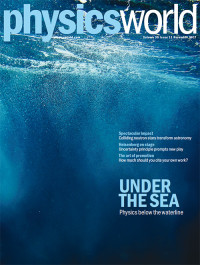
Under the sea: the November 2017 issue of Physics World is now out
 By Matin Durrani
Physicists love a challenge. Some have experiments up in space, while others work deep underground or at the tops of mountains. But just imagine how hard it must be for the those physicists who do experiments at sea.
The November 2017 issue of Physics World, which is now out in print and digital format, examines some of the challenges for physicists working below the waterline.
Jon Willis describes his experience on the exploration ship Nautilus in the Pacific Ocean, looking for mineral-rich “black smokers” that support life in conditions mimicking those on Jupiter’s icy moon Europa. Helen Czerski reveals why her studies of bubbles could help those who model climate change, while Antoine Kouchner and Véronique Van Elewyck explain why and how researchers are using the ocean as a giant neutrino detector.
Remember that if you’re a member of the Institute of Physics, you can read the whole of Physics World magazine every month via our digital apps for iOS, Android and Web browsers.
View all posts by this author | View this author's profile
The physics of bread, the quest for metallic hydrogen and adventures in LIGO land
 By Matin Durrani
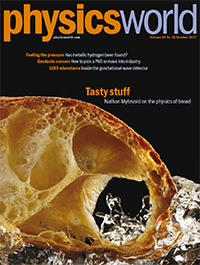
If you’re a student wondering whether to go into research or bag a job in industry, don’t miss our latest Graduate Careers special, which you can read in the October issue of Physics World.
Philip Judge from the US National Center for Atmospheric Research and his colleagues Isabel Lipartito and Robert Casini first describe how budding researchers should pick a PhD to work on. It’s vital as that first project can determine the trajectory of your future career.
But if your eyes are set on a job outside academia, careers guru Crystal Bailey from the American Physical Society runs through your options and calls on academics to learn more about what’s on offer so they can advise their students better.
If you’d rather just stick your head in the sand about your career options, however, then why not enjoy the cover feature of the October issue, in which former Microsoft chief tech officer and Intellectual Ventures boss Nathan Myhrvold discusses his massive new five-volume treatise Modernist Bread.
Mixing history and science – as well as the results of more than 1600 of his own experiments – the book is sure to be the last word on this foodstuff that humans have been baking for millennia.
Don’t miss either Jon Cartwright’s feature on the quest for metallic hydrogen.
Remember that if you’re a member of the Institute of Physics, you can read the whole of Physics World magazine every month via our digital apps for iOS, Android and Web browsers.
View all posts by this author | View this author's profile
The September 2017 issue of Physics World magazine is now out
 By Matin Durrani
Some of the daily challenges facing women in physics are tackled in the latest issue of Physics World magazine, which is now out.
As well as a round-up from the recent International Conference on Women in Physics, which took place in Birmingham, UK, there’s a fascinating feature about the life of Jocelyn Bell Burnell. She discovered pulsars 50 years ago next month and became the first female president of the Institute of Physics, which publishes Physics World.
As Bell Burnell points out, “Fix the women!” is often seen as the solution to why women progress more slowly in physics than men. In fact, she argues, larger problems – notably institutional bias and poor policies – are to blame.
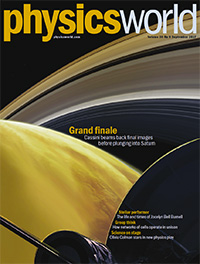
Don’t miss either our cover feature on the stunning images Cassini has been beaming back over the last few months before it plunges into Saturn on 15 September. We’ve also got a great Lateral Thoughts article by Daniel Whiteson, illustrated by PHD Comics artist Jorge Cham. Plus, find out how groups of cells move, communicate and organize themselves in networks.
Remember that if you’re a member of the Institute of Physics, you can read Physics World magazine every month via our digital apps for iOS, Android and Web browsers.
View all posts by this author | View this author's profile
Our hazardous planet: when the world is out to get you
 By Matin Durrani
For people afflicted by last month’s devastating fire at Grenfell Tower in London or for those caught up in recent terrorist atrocities, it can seem that many problems in this world are entirely of our own making.
Yes the modern world has benefited from our collective wisdom and creativity – especially through science and engineering – but often it feels as if irrational human behaviour lies at the root of many of our troubles.
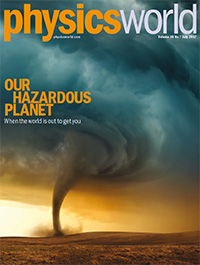
Nevertheless, we should remember that our planet itself holds many natural hazards too, as the latest special issue of Physics World reminds us.
Remember that if you’re a member of the Institute of Physics, you can read Physics World magazine every month via our digital apps for iOS, Android and Web browsers.
View all posts by this author | View this author's profile
Fermilab at 50: the June 2017 issue of Physics World is now out
 By Matin Durrani
With America’s iconic Fermi National Accelerator Laboratory (Fermilab) celebrating its 50th anniversary this month, check out the June 2017 issue of Physics World magazine, which is now live in the Physics World app for mobile and desktop.
Fermilab mades its name with the Tevatron proton–antiproton collider but neutrinos hold the key to the lab’s future, as Ben Still from Queen Mary University of London makes clear in a feature on the physics of these elusive particles.
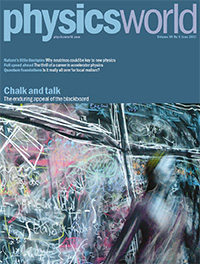
You can also enjoy a cracking review of Tommaso Dorigo’s new warts-and-all account of life in the CDF collaboration at Fermilab, while Seyda Ipek from the lab pops up in Philip Ball’s homage to the blackboard – which you can also read on physicsworld.com.
Plus don’t miss this month’s Lateral Thoughts, which reveals how one physicist working in a Scottish call centre ended up chatting to Enrico Fermi’s daughter-in-law about her TV.
Remember that if you’re a member of the Institute of Physics, you can read Physics World magazine every month via our digital apps for iOS, Android and Web browsers.
View all posts by this author | View this author's profile
The May 2017 issue of Physics World is now out
 By Matin Durrani
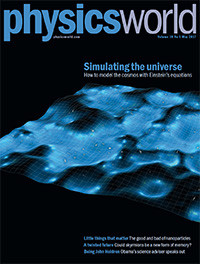
Einstein’s equations of general relativity might fit on a physicist’s coffee mug, but solving them is no mean feat. Now, however, the equations have been solved in a cosmological setting for the first time, as Tom Giblin, James Mertens and Glenn Starkman explain in the May 2017 issue of Physics World magazine, which is now live in the Physics World app for mobile and desktop
Elsewhere in the issue, you can enjoy an interview with John Holdren, who spent eight years as Barack Obama’s presidential science adviser. Find out too about the good and bad of nanoparticles and explore the potential that skyrmions – magnetic quasiparticles – could hold as a new form of memory storage.
Don’t miss either this month’s Lateral Thoughts, in which physicist Roger Todd describes how his invention of a system for automatically watering his house plants almost led to a commercial device.
Remember that if you are a member of the Institute of Physics, you can read Physics World magazine every month via our digital apps for iOS, Android and Web browsers.
View all posts by this author | View this author's profile
From blue fogs to Brexit – the April 2017 issue of Physics World is now out
 By Matin Durrani
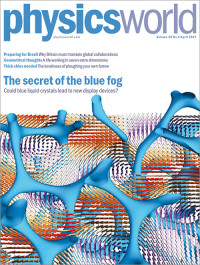
“The secret of the blue fog” might sound like a Tintin book, but it’s all about a strange form of liquid crystal that’s the cover story in the April 2017 issue of Physics World magazine, which is now live in the Physics World app for mobile and desktop.
First observed in the late 1800s, only recently have we finally uncovered the structure of these materials, which turn blue when cooled. As Oliver Henrich and Davide Marenduzzo explain, blue liquid crystals could be used for new kinds of display devices.
Elsewhere in the issue, mathematical physicist Jason Lotay explains his work in seven extra dimensions, while science writer Benjamin Skuse examines the challenge for respected physicists with theories outside the mainstream.
Don’t miss either our latest look at Donald Trump’s scientific shenanigans, including an interview with Rush Holt – the physicist-turned-politician who’s now head of the American Association for the Advancement of Science.
Remember that if you are a member of the Institute of Physics, you can read Physics World magazine every month via our digital apps for iOS, Android and desktop.
View all posts by this author | View this author's profile

