
![[IOP]](http://images.iop.org/cws/icons/themes/phw/colophon-small.png)


Category Archives: General
Got your physics degree… now what?
 By Tushna Commissariat
Last year, we launched our first ever Physics World Careers guide, which brought together all of our best content from the careers section of our monthly magazine, together with an extensive directory of employers. This year, we’re back with the bigger Physics World Careers guide 2018, packed with case-studies and analyses, to help you choose the right path for your future – as James McKenzie, vice-president for business at Institute of Physics point out in his foreword for the guide, “As physicists, you will have learnt to be logical, analytical and articulate. These are skills that are highly prized by employers and open up many career paths for you.”
View all posts by this author | View this author's profile
12 things we learned about the National Physical Laboratory
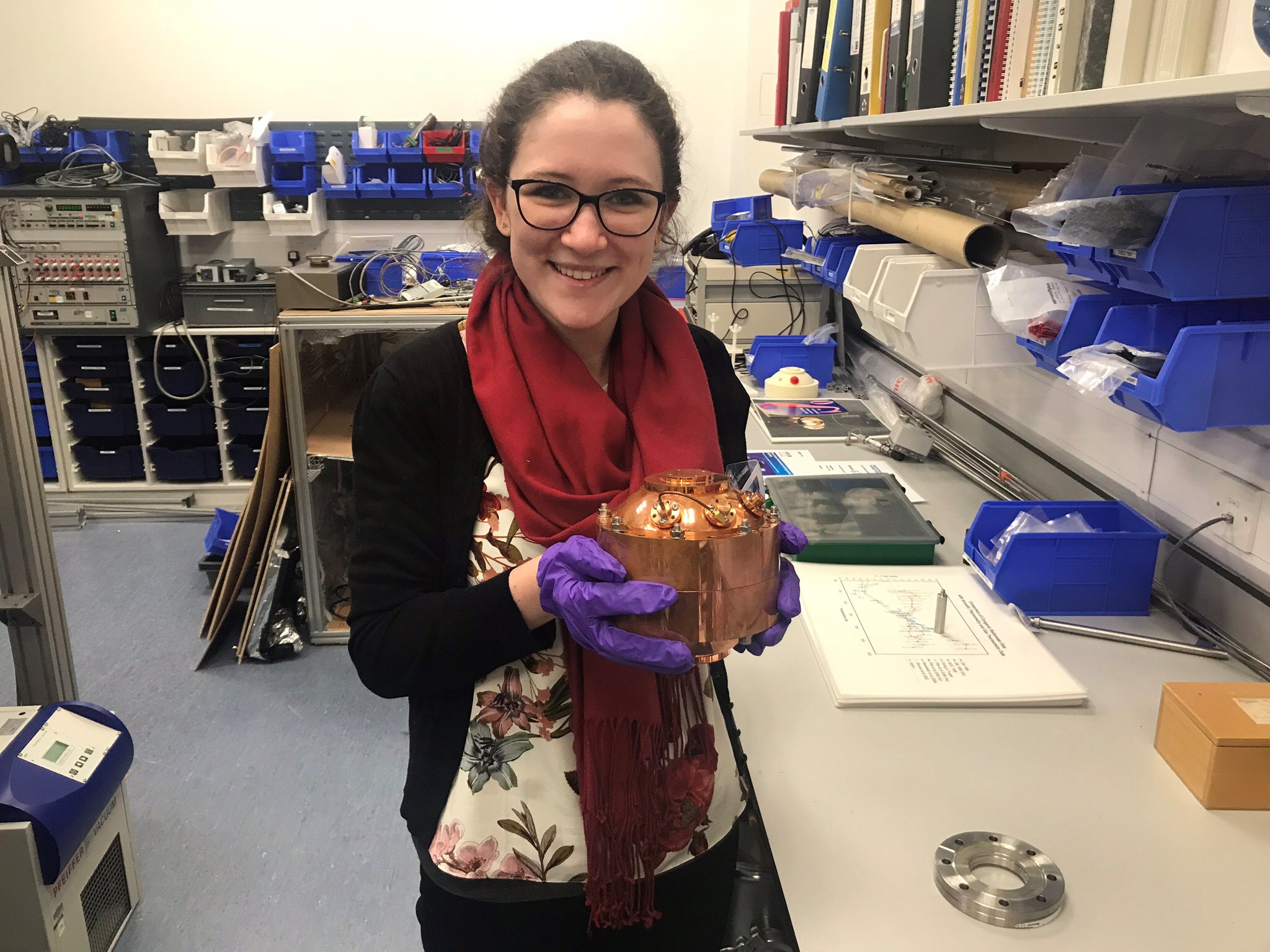
Hands-on physics – Sarah Tesh with a replica of the device used to measure temperature at the National Physical Laboratory
By Matin Durrani and Sarah Tesh
Here at Physics World we’re planning to publish special issues later this year on time (in July) and on SI units and measurement (in November). So to find out more about the latest work in these fields, we decided to accept a long-standing invitation to visit the National Physical Laboratory in Teddington, just outside London, yesterday.
The NPL is the UK’s national measurement laboratory and, as we found out on our visit yesterday, it’s home to almost 900 staff. Or, to be precise, there are 879 staff – after all, accuracy is the name of the game for the NPL, which provides vital measurement services to industry and plays a key part in global attempts to revise the SI measurement system.
It was a busy day for us and we came away with some useful ideas for possible articles for those two Physics World special issues. But rather than giving you a detailed run-down of everything we saw, here instead are 12 “fun” facts we picked up during our visit. Sometimes it’s those little details that make lab visits so intriguing.
View all posts by this author | View this author's profile
The February 2018 issue of Physics World magazine is now out
 By Matin Durrani
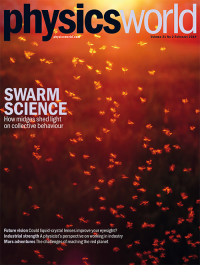
You’ll be delighted to know that the February 2018 issue of Physics World is now out in print and digital format.
In our cover feature this month, science writer Jennifer Ouellette discovers how tiny midges can shed light on collective behaviour in physics. You can also discover from Helen Gleeson how physicists are seeking to create liquid-crystal contact lenses – and learn from Stephen Ornes more about the technological challenges of going to Mars.
Don’t miss either our interview with the physicist who heads Japan’s leading funding agency and find out from astrophysicist Elizabeth Tasker about her experiences as an overseas scientist in the country.
And our veteran North America correspondent Peter Gwynne assesses the impact that Donald Trump has had on US science, one year into his presidency.
Remember that if you’re a member of the Institute of Physics, you can read the whole of Physics World magazine every month via our digital apps for iOS, Android and Web browsers.
Let us know what you think about the issue on Twitter, Facebook or by e-mailing us at pwld@iop.org
View all posts by this author | View this author's profile
A virtual tour of virtual reality
By Margaret Harris at Photonics West in San Francisco
“How many people in this room are wearing smart glasses today?”
When Bernard Kress, a photonics expert and optical architect on Microsoft’s HoloLens smart-glasses project, posed this question at the Photonics West trade show, he had reason to expect a decent response. He was, after all, speaking at a standing-room-only session on virtual reality, augmented reality and mixed reality (VR, AR and MR), and the audience was packed with tech-friendly, early-adopter types who had come specifically because they’re interested in such devices. Surely, someone in the audience would put up their hand.
View all posts by this author | View this author's profile
Watch the super blue blood moon eclipse live
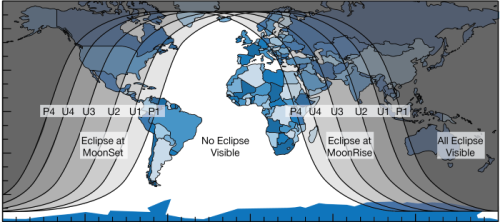
Eclipse watching: where the blood moon will be visible (Courtesy: NASA)
By Hamish Johnston
Tomorrow, people around much of the world should be able to see a lunar triple-whammy. There are two full moons this month, which is a relatively rare occurrence called a blue moon. The Moon is also near its closest approach to Earth, which means that it will loom large in the sky as a super moon.
View all posts by this author | View this author's profile
Name that column
By Margaret Harris
Covering the commercial side of physics has its challenges. Because physics is such a diverse subject, people who train as physicists find their way into a host of different industries. Once there, they tend to blend in with graduates of other scientific disciplines, who are both more numerous and more likely to have their field in their job title: “physicist” is a relatively uncommon title compared to, say, “engineer”. It also doesn’t help that companies, unlike universities, almost never encourage employees to set up official, publicly accessible websites with contact info and details of what they’re working on right now.
But just because something is difficult doesn’t mean it shouldn’t be done, and one of Physics World’s resolutions for 2018 (right behind laying off the biscuits and getting more exercise) is to put more emphasis on covering industrial and applied physics. As part of that, we’re introducing a new column in the magazine that will explore the interactions between physics, industry and business in general. In this way, we hope to raise the profile of physicists in industry and, by extension, to emphasize the value that physicists bring to the commercial sector.
View all posts by this author | View this author's profile
See in the new year with the January 2018 issue of Physics World
By Matin Durrani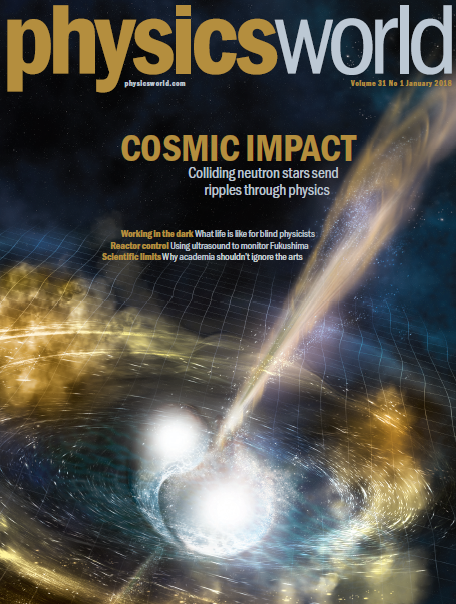
Happy new year and welcome back to Physics World after our winter break. Why not get 2018 off to a great start with the January 2018 issue of Physics World, which is now out in print and digital format.
In our fantastic cover feature this month, Imre Bartos from Columbia University in New York examines the massive impact on physics that last year’s spectacular observation of colliding neutron stars will have.
Elsewhere, Bruce Drinkwater from the University of Bristol explains how he is using ultrasonics to monitor the damaged Fukushima nuclear-power plant in Japan, while science writer Jon Cartwright looks at how technology can help blind physicists.
Don’t miss either our interview with Fermilab boss Nigel Lockyer and do check out our tips for how to brush up your CV if you’re chasing a job in industry.
View all posts by this author | View this author's profile
A very LIGO Christmas
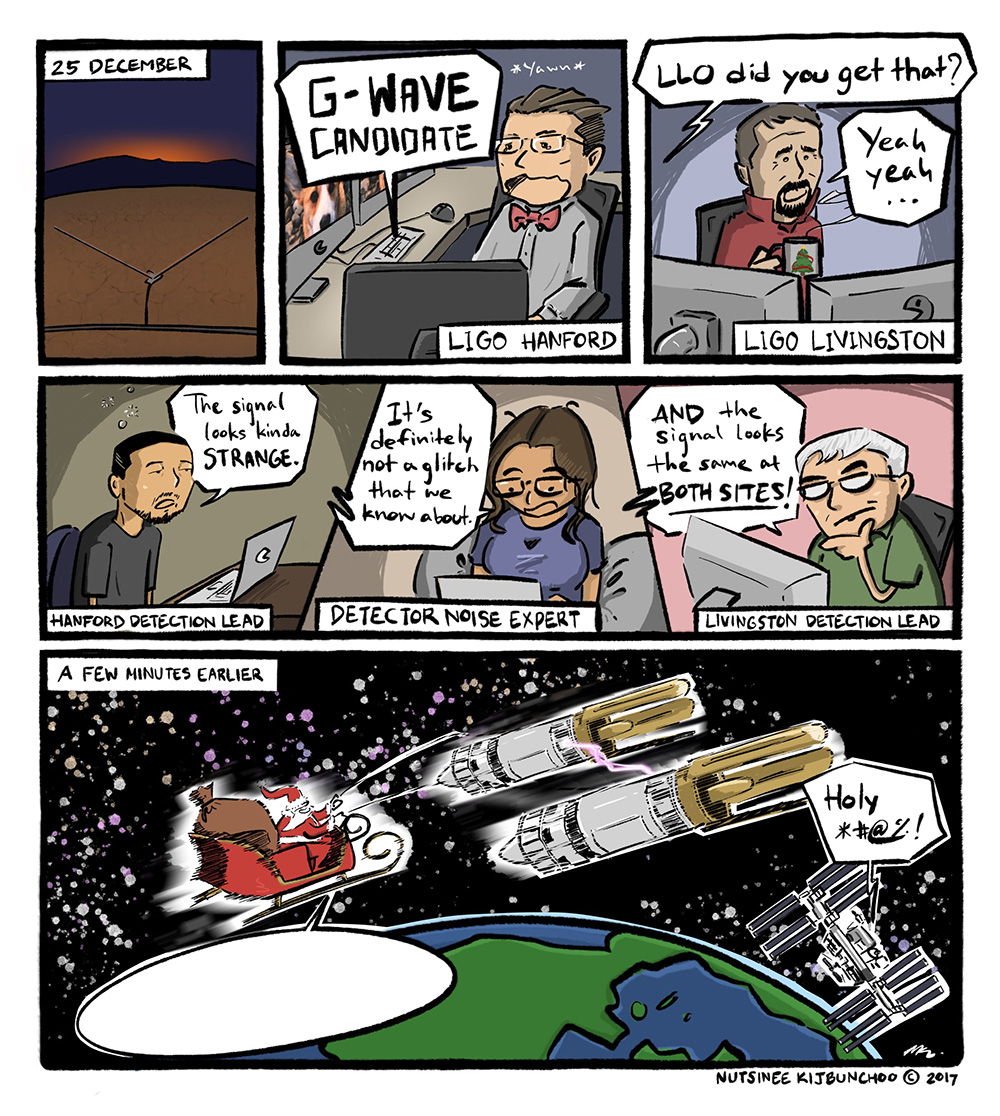
Light speed: LIGO gets a surprise signal (click to expand)
By Tushna Commissariat
Every December, we like to do something special for you, dear readers, as the year draws to an end. As you are undoubtedly aware, some of the most exciting news in physics this year came from the world of gravitational-wave research and multimessenger astronomy, in the first ever observation of a neutron-star merger. Indeed, this global discovery bagged our 2017 Breakthrough of the Year award, while the pioneers of gravitational-wave astronomy won this year’s Nobel prize in physics.
View all posts by this author | View this author's profile
Reviewing a year in industry
By Margaret Harris
Normally when someone talks about their “year in industry”, they’re referring to a period spent working for a company. My own “year in industry” has been rather different: instead of spending 2017 working in a physics-based industry, I’ve been reporting on half a dozen different ones. From nuclear energy and nanotechnology to optics and instrumentation, I’ve heard from physicists who’ve founded new firms, developed new products and navigated their way through tricky waters with financial backers. Here are a few highlights.
2017 was another high-profile year for physicist and entrepreneur Elon Musk, with his company SpaceX landing a re-used Falcon 9 rocket back in March and his other firm, Tesla Motors, starting to deliver its much-anticipated Model 3 to mere mortals just this week. But in between, there was also a little bit of hype about Musk and hyperloops: vacuum-based systems that could, according to proponents, transport passengers cheaply at more than half the speed of sound. It sounds far-fetched, but as Jon Cartwright revealed in this feature article for August’s Physics World Focus on Vacuum and Instruments, it’s an idea with a long history.
View all posts by this author | View this author's profile
World’s smallest Christmas card and a fusion Christmas number one
By Hamish Johnston
We are winding down for Christmas here at Physics World and taking a well-deserved break before we launch into 2018.
Over the next week or so, stay tuned for festive content including a comic caption competition on Christmas Day that is inspired by this year’s Nobel prize.
View all posts by this author | View this author's profile

