
![[IOP]](http://images.iop.org/cws/icons/themes/phw/colophon-small.png)


Tag archives: Kepler
Radiation blasts render Earth’s twin inhospitable to life
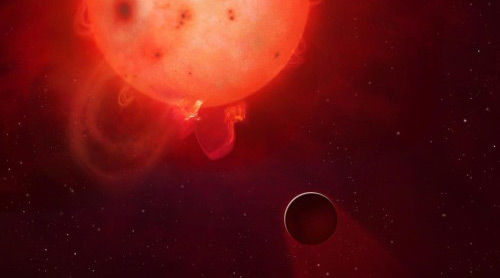
Radioactive? Kepler-438b is regularly irradiated by huge flares of radiation from its host star. (Courtesy: Mark A Garlick/University of Warwick)
By Tushna Commissariat
In the past decade or two, exoplanetary research has been booming as NASA’s Kepler telescope and its cohorts have found nearly 2000 exoplanets and 5000 promising candidates. Unsurprisingly, we have been searching long and hard for those planets that could be habitable or are as similar in shape, size and proximity to the host star as the Earth is to the Sun. Indeed, in January this year Kepler scientists announced that they had found the most Earth-like planet to date – Kepler-438b – orbiting within the habitable zone of its host star, the red dwarf Kepler-438, which lies about 470 light-years from Earth.
The planet, which is slightly bigger than our own, was found to be rocky, and, thanks to its location, rather temperate, meaning that it could have flowing water on it – two key factors that astronomers look for when accessing a planet’s habitability. Unfortunately, David Armstrong of the University of Warwick in the UK and colleagues have now found that Earth’s twin is regularly bathed in vast quantities of radiation from its star – a real dampener when it comes to the formation of life as we known it.
View all posts by this author | View this author's profile
Exoplanets are everywhere
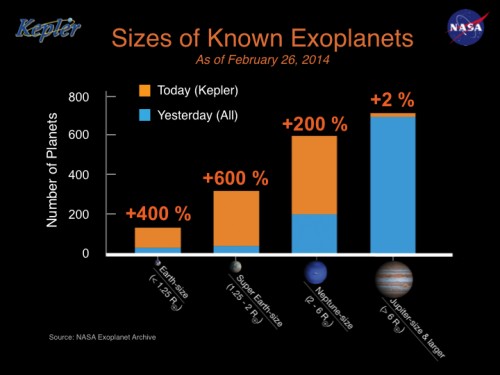
The latest haul of exoplanets is skewed towards Earth-like masses. (Courtesy: NASA)
By Hamish Johnston
Just a few years ago the idea that more than 700 exoplanets could be discovered in a single study would seem fantastical. But that’s exactly what astronomers working on NASA’s Kepler mission have just done.
View all posts by this author | View this author's profile
Kepler telescope goes into retirement…for now
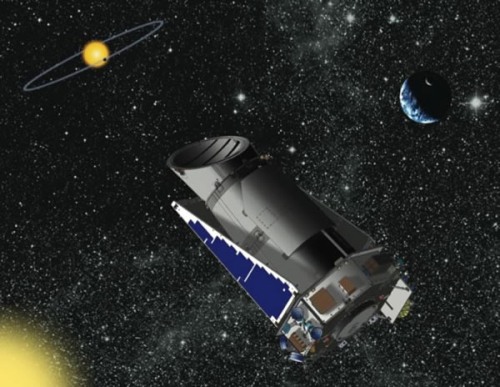
Retirement among the stars: Artist’s concept of the Kepler spacecraft. (Courtesy: NASA/JPL-Caltech/Ball)
By Tushna Commissariat
A few months ago, I wrote a blog about NASA’s Kepler space telescope being in a spot of trouble, as the spacecraft shut down and went into “safe mode”. The problem was that two of the four gyroscope-like “reaction wheels” that help the telescope remain steady and pointed in a particular direction had broken. Since May, researchers have been looking at ways and means to fix the problem or work around it.
Unfortunately, after analysing and testing the systems, the Kepler Space Telescope team has decided to end its attempts to restore the spacecraft to full working order, and is now “considering what new science research it can carry out in its current condition”.
View all posts by this author | View this author's profile
Kepler – it’s not all doom and gloom just yet
By Tushna Commissariat
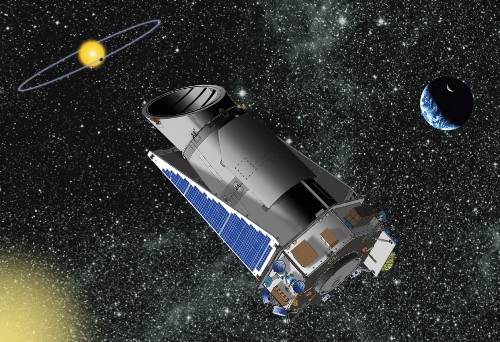
NASA’s Kepler space telescope. (Courtesy: NASA)
To much general dismay, earlier this month NASA officials announced that their Kepler space telescope had gone into a self-imposed “safe mode”, something that the telescope is programmed to do if one of its primary systems is not fully functional. Although the telescope was then rebooted, it shut down again this week and it seems that all is definitely not well with our favourite exoplanet spotter: the mission collaboration announced that the instrument has suffered a critical failure and may never be fully operational again.
View all posts by this author | View this author's profile
Of mice and ‘little green men’
By Tushna Commissariat

Just called to say hello?
(Wikimedia Commons/Crobard)
There’s nothing quite like mentioning extraterrestrials or aliens to get us “Earthlings” all excited or riled up! Late last week, a paper popped up on arXiv, by astronomer Alan Penny from the University of St Andrews. He outlines an incident where, for a short while, the possibility of alien contact was seriously considered. He was talking about what was ultimately the discovery of the first pulsar; but at the time the researchers couldn’t help but wonder if they had come across the first “artificial signal” from outer space.
The exciting happenings began in August 1967, when Jocelyn Bell Burnell (then a graduate student working with Antony Hewish – controversially, only Hewish won the Nobel prize for the pulsar discovery in 1974) at the University of Cambridge, noticed a particular source that had a “flickering pattern” that, over a few weeks, she realized showed up regularly each day at the same sidereal time. That December Bell pinpointed the specific position of the source in the sky using another telescope and the discovery was confirmed. In the coming months, three more similar patterns were found and the researchers agreed on “pulsating stars” or pulsars being the source. But during those winter months, the possibility that they had encountered the first alien signal loomed large. In fact, Brunell and colleagues dubbed the first pulsar LGM-1 or “Little Green Men”; although it was changed to CP 1919, and is now known as PSR B1919+21.
View all posts by this author | View this author's profile
Hubble – one million and going strong

By Tushna Commissariat
I have already raved on about the awesomeness of the Hubble Space Telescope in my blog entry about its 21st anniversary in April this year. Now, the telescope has crossed yet another milestone – on Monday 4 July the Earth-orbiting observatory logged its one-millionth science observation! The image above is a composite of all the various celestial objects ranging through stars, clusters, galaxies, nebulae, planets, etc that Hubble has catalogued over the years. Click on the image for a hi-res version. [Credit: NASA, ESA and R Thompson (CSC/STScI)]
The telescope has had a significant impact on all fields of science from planetary science to cosmology and has provided generations with breathtaking images of our universe ever since it was launched on 24 April 1990 aboard Discovery’s STS-31 mission.
Hubble’s counter reading includes every observation of astronomical targets since its launch. The millionth observation made by Hubble was during a search for water in the atmosphere of an exoplanet almost 1000 light-years away from us. The telescope had trained its Wide Field Camera 3, a visible and infrared light imager with an on-board spectrometer on the planet HAT-P-7b, a gas giant planet larger than Jupiter orbiting a star hotter than our Sun. HAT-P-7b has also been studied by NASA’s Kepler telescope after it was discovered by ground-based observations. Hubble now is being used to analyse the chemical composition of the planet’s atmosphere.
“For 21 years Hubble has been the premier space-science observatory, astounding us with deeply beautiful imagery and enabling ground-breaking science across a wide spectrum of astronomical disciplines,” said NASA administrator Charles Bolden. He piloted the space shuttle mission that carried Hubble to orbit. “The fact that Hubble met this milestone while studying a far away planet is a remarkable reminder of its strength and legacy.”
Hubble has now collected more than 50 terabytes – the archive of that data is available to scientists and the public at http://hla.stsci.edu/
And take a look at this Physics World article by astrophysicist Mark Voit where he looks at the most iconic images Hubble has produced over the years – Hubble’s greatest hits
The NASA video below was created last year for the 20th Hubble anniversary celebration and tells you how you could send a message to Hubble that will be stored in its archive.
View all posts by this author | View this author's profile

